
Arcora Counselling Brings Well-being Full Circle
Experience the full journey of Arcora’s counselling services and see the benefits for employees and organizations alike.
We combine robust, scientifically rigorous research with a compassionate and distinctly human approach to offer top-tier Mental Well-being (EAP) Solutions.
Human-centered, Backed by Research
People are the foundation of everything we do.
At Arcora, this simple truth is our beacon—ensuring we always prioritize a human-centred approach with empathy, trust and care at its core. We meet people where they are by delivering compassionate support that honours their individual needs and challenges. It feels personal because it truly is.
Join us on this comprehensive journey through Arcora’s counselling services, from intake to outcomes. You’ll see how our unique approach—supported by leading-edge research, data science and technology—leads to transformative change for employees and organizations.
We leverage robust outcome assessments and pretest-posttest data to measure impacts, learn from results and refine our services. It’s what sets Arcora apart: we’re continually improving, while offering evidence-based, whole-person solutions with meaningful results. Our EAP mental health services are rooted in connection and understanding, and designed to address immediate needs while giving clients the tools to build resilience for lasting benefits.

Arcora’s counselling brings well-being full circle. It’s a ripple of positive change that starts with individuals, transforms teams and uplifts entire organizations.
Awareness of Need
The journey starts when an employee recognizes that the issues they’re experiencing are negatively impacting one or more areas of their life. This leads to a crucial realization—they need support.
Employees who seek counselling support are facing common challenges.
Our findings show that all employees who reach out to Arcora for counselling are experiencing personal issues affecting one or more of these areas:

- Mental health
- Physical health
- Performance at work
- Quality of life
- Ability to function normally
We see the wide reach that personal issues have—often affecting several facets of employees’ lives. With accessible and effective counselling support, Arcora offers the solution to addressing these underlying issues and helping employees see positive changes.
Data Snapshot: Common Challenges
Percentage of employees who indicated experiencing negative impacts in each area:
- Mental health: 85%
- Physical health: 70%
- Performance at work: 65%
- Quality of life: 50%
- Ability to function normally: 40%
Based on 4,000 Canadian employees accessing Arcora counselling.
Building Awareness to Increase Access
Once an employee recognizes they need help, knowing where and how to seek support is a crucial next step. This is where HR and business leaders are instrumental. By understanding the scope of personal challenges employees face and taking proactive steps to prioritize well-being in the workplace, they can help create a more resilient, engaged and productive organization. This requires more than offering wellness supports—employee awareness is key.
A study supported by Arcora that explored EAP treatment stigma1 found that increasing familiarity with EAPs not only reduces stigma but also significantly increases the likelihood that employees will access services when they need them. Education around these supports empowers employees to prioritize their well-being.
Unlocking Understanding
Increasing awareness of well-being supports includes ensuring employees understand what’s available, how the supports can help and how to access them.
Arcora’s Mental Well-being (EAP) Solutions
Supports available
Arcora solutions commonly include up to 12 hours of counselling per year (individuals, couples and family), which is substantial compared to many other EAPs.
Recognizing that there is considerable time available to work through challenges can motivate employees to access supports.
How to access
Arcora makes the difficult step of reaching out for help easier by offering a compassionate intake experience either by phone or online.
Having a choice in intake access can helps employees feel comfortable in starting their counselling journey.
How they Help
With an outcome-focused, goal-oriented approach and over 70 different counselling methodologies offered in our network, Arcora’s counselling can help with:
- personal struggles (depression, anxiety, coping with bereavement, etc.),
- family and relationship challenges (marital, parenting, etc.),
- work-related difficulties (stress and burnout, interpersonal problems, etc.) and
- dependency concerns (excessive substance use and other addictions).
Knowing supports are evidence-based and designed to address a wide variety of challenges can boost employees’ confidence in the benefits of counselling—both immediate and long-term.
1 Milot, M. (2019). EAP Treatment Stigma as a Barrier to Employee Help-Seeking: Predictors and Validation of a Brief Scale for its Measurement. EASNA Research Notes, Vol. 8, No. 2.
The Intake Experience
After recognizing a need for support, reaching out is the next step. It seems simple, but in reality, asking for help can be incredibly difficult. We understand that fear or uncertainty creates a potential barrier to accessing mental health services—and prioritize an empathetic, human intake experience that includes a choice in how to connect with Arcora.
Flexibility is Key
Providing person-focused care means offering flexibility from first contact. Knowing that intake is much more than an administrative function, we ensure every client is greeted with empathy and understanding, whether they choose to call and speak directly with a member of our experienced team or complete our online form.
Offering a choice in access empowers clients by providing support that works best for them.
A Human-Centered Approach
Arcora’s intake staff are specifically trained to:
- Acknowledge each person’s unique challenges
- Provide reassurance and guidance
- Ensure a seamless and supportive experience from the very first interaction
Data Snapshot: Intake Experience
Our findings, including Arcora client insights—highlight the importance of the intake process in creating a positive first impression, fostering trust and encouraging employees to move forward with confidence.
- 94% of employees reported feeling more confident in their ability to handle their issues after speaking with an Arcora intake coordinator.
- 92% of employees reported a positive experience with Arcora’s intake staff—specifically, being satisfied with their attitude and the service provided.
- 83% of employees were satisfied with the process of completing the online form.
The Intake Experience and Client Confidence
Arcora data shows a link between satisfaction with the intake process and employees’ confidence in addressing their issues.

Employees who reported higher satisfaction with their interactions during intake were also more likely to report increased confidence in their ability to handle their concerns2.
This underscores the meaningful impact of a positive, empathetic experience—especially early in the care journey. When employees feel heard and supported, they’re more likely to trust the process and believe in their ability to face challenges.
2 This relationship is reflected in a Cohen’s d of approximately 0.4, indicating a medium effect size. It is important to note that this observation is correlational, and other factors may contribute to confidence levels.
Timely Access
Once an employee has reached out for support, timely access to care is the critical next step. In order to maintain the momentum built during those initial stages, Arcora works to promptly connect clients and counselling professionals and eliminate unnecessary delays.
Our client insights indicate that most employees are in contact with a counsellor within a day or two of connecting with Arcora, and have their first session within a week. In comparison, many Canadians without EAP access face significant challenges when seeking mental health services in the public or even private sphere.
Data Snapshot: Timely Access
- 72% of employees are in contact with a counsellor within two days of intake.
- 80% of employees have their first counselling session within one week of intake.
Arcora’s dedication to timely, accessible care gets employees the support they need when they need it most.
Public counselling services
Access often involves long wait times:
- 1 in 2 Canadians wait up to one month for community mental health counselling, while 1 in 10 wait four or more months3.
- In Quebec, the average wait time is even higher—between six and 24 months4.
Private counselling services
Access is often time-consuming, costly and uncertain:
- Finding and vetting potential counselling professionals falls to the individual.
- Matching with the right provider is difficult due to varied availability and a lack of structured support.
- Financial barriers remain significant and can deter people from pursuing ongoing care, as private counselling often costs hundreds of dollars per session.
Arcora’s counselling services
Timely, reliable access to services and a comprehensive matching process that pairs clients with right counsellor based on their needs—all at no additional cost to employees.
Arcora eliminates the uncertainty, effort and financial burden often involved in navigating public or private services.
By addressing barriers to access, Arcora’s mental well-being solutions not only support employee wellness but also reduce the risks associated with untreated mental health challenges in the workplace.
This seamless transition from intake to counselling exemplifies Arcora’s human-centered approach and dedication to empowering employees on their well-being journey.
3 Canadian Institute for Health Information (2024). Wait Times for Community Mental Health Counselling.
4 Canadian Mental Health Association (2024). The State of Mental Health in Canada 2024: Mental Health in Québec.
Flexible Delivery
Arcora’s counselling journey is designed to make employees feel empowered and supported at every step. When it comes to service delivery, this means allowing clients to choose how they access counselling. With in-person, phone, virtual and hybrid options, employees can get the care they need in a way that works best for them.
Arcora offers a seamless, tailored experience that meets employees where they are—both physically and emotionally.
Data Snapshot: Employee Preferences in Counselling Access
Recent Arcora client insights reveal a clear trend in how employees like to receive our counselling:
- 46% prefer virtual sessions.
- 40% prefer in-person sessions.
- 14% prefer a hybrid approach that combines various options.
Our findings demonstrate that while preference for virtual sessions is highest, a significant proportion of employees value the opportunity to access in-person or, to a lesser extent, hybrid care. By having several delivery options, Arcora ensures that every employee can engage with effective mental health support that fits their needs.
We set the tone for each client’s mental health journey—balancing self-determination and dedicated support so that employees feel seen, heard and respected from the start.
A Person-First Philosophy of Care
While much of the industry focuses on whether outcomes differ across various counselling modalities, we recognize that people’s diverse needs and preferences go beyond how they access support. There are many aspects of the counselling journey that may impact outcomes, so we emphasize the overall client experience.

Arcora’s flexible approach includes a range of access options for both intake and counselling services—just some of many ways we eliminate barriers and create a distinctly human experience.
Personalized Matching
Arcora’s human-centred and data-informed matching process is a cornerstone of our approach, setting us apart from other EAP providers. We know that the therapeutic alliance—the strength of the client-counsellor relationship—is a key indicator of successful outcomes, so we prioritize this match throughout the entire counselling journey.
A Framework for Strong Connections
Arcora’s matching process begins during the intake stage and relies on the following factors.
1. Our network
Our extensive national network includes counselling professionals who offer a multitude of therapeutic approaches. We have high expectations and service standards to ensure that our clients consistently receive quality care.
2. Our research
Our advanced, proprietary algorithm generates comprehensive metrics for the counsellors in our network with data from areas of expertise, effectiveness and client satisfaction.
3. Our people
Our intake process is thorough, offering clients the option to share specific details of what they are looking for in a counsellor (including gender identity, lived experiences and spiritual background). Behind this process is our highly trained intake staff, who use their expertise to assess each client’s circumstances and select the most appropriate counsellor for their needs, preferences and the challenges they are facing.
These three aspects are the framework of our process—combining data with a human touch. Arcora’s intake staff make informed, personalized matching decisions pair employees with experienced professionals who are best equipped to meet their specific needs.
The Therapeutic Alliance and Positive Outcomes
Arcora’s research demonstrates the fundamental tie between the client-counsellor relationship and the benefits gained through counselling5. Employees with higher therapeutic alliance scores also reported:
- Reduced symptoms of depression, with an increase in mental well-being and life satisfaction.
- Reduced presenteeism (working while unwell), with an increase in work engagement.
These findings highlight how a strong therapeutic alliance, built on trust and collaboration, creates the foundation for positive change.
Data Snapshot: Therapeutic Alliance
87% of employees reported a high therapeutic alliance with their counsellor.
This is measured by the Brief Therapeutic Alliance Scale, developed with Arcora research5, which evaluates dimensions that are essential for fostering a meaningful therapeutic relationship, including support, trust and collaboration.
To ensure we continue creating meaningful client-counsellor relationships, we actively monitor our matching process—tracking metrics and refining our approach to ensure every interaction aligns with our commitment to responsive client care.
5 Milot, M. (2022). The therapeutic alliance as an indicator of well-implemented and impactful employee counseling services: Deployment of the Brief Therapeutic Alliance Scale in an employee assistance program. Journal of Workplace Behavioral Health, 38(1), 10–35.
Solution-focused Supports
Once an employee has been matched with their counsellor, they’ve reached the support stage. Arcora’s network offers access to dozens of common therapeutic approaches, including cognitive behavioural therapy (CBT) and mindfulness-based therapies. Most importantly, our programs are designed to be goal-oriented, outcome-focused and evidence-based. In other words, we focus on solutions.
A Practical Foundation for Workplace Counselling
This solution-focused approach is foundational to our supports. It’s also ideal for workplace counselling, which relies on impactful but timely care. Arcora’s method emphasizes brevity and collaboration, while building on existing strengths and past successes. From the first session, clients and their counsellors work together to identify pressing challenges and create actionable strategies to address them. Starting with clear goals ensures that every session contributes to measurable change, helping employees find practical solutions and meaningful outcomes.
This approach reflects our commitment to delivering transformative counselling experiences that address the unique demands of workplace settings.
Data Snapshot: A Successful Approach
Our findings show that counsellors in our network consistently rely on solution-focused strategies, which correlate with positive outcomes.
- 97% of employees indicated that their counsellor employed solution-focused methods during their sessions, while 90% reported these methods were used most or all of the time.
- Arcora clients who reported more solution-focused counselling also reported higher satisfaction with their counsellor6.
Nuanced Care That Empowers Clients
By combining a solution-focused foundation of care with a breadth of evidence-based therapeutic approaches, Arcora ensures clients receive practical, personalized support. This focus equips employees with effective strategies for navigating challenges, while setting the stage for long-term improvements.
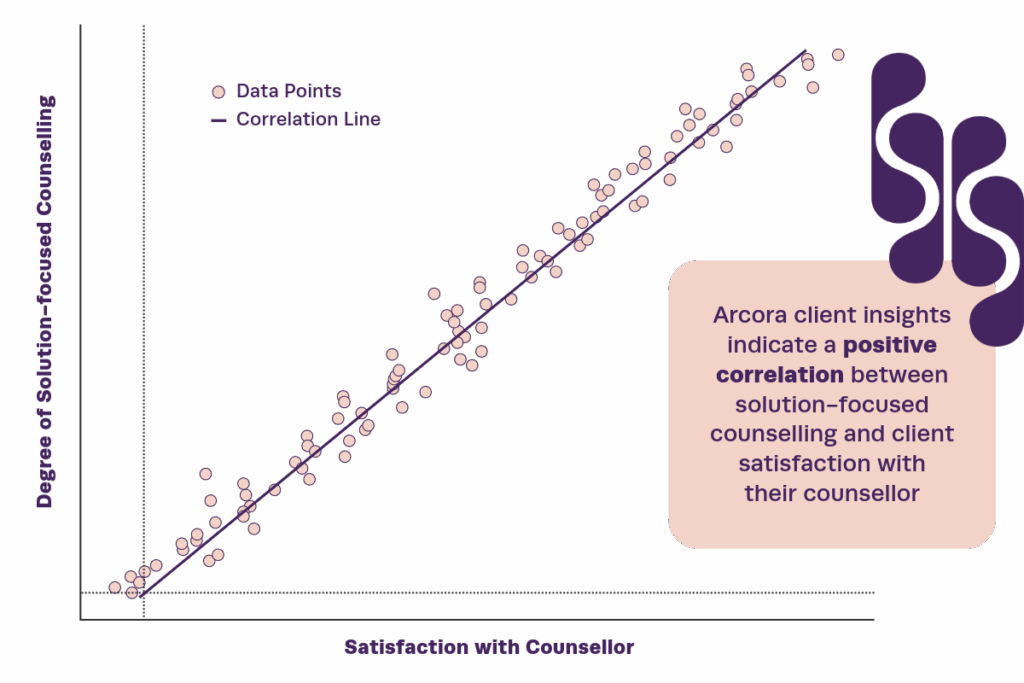
6 A correlation of 0.749 was observed between the degree of solution-focused care reported by clients and their satisfaction with counsellors, corresponding to a very large effect size (Cohen’s D) of 2.27.
The Clinical Hour for Quality Counselling
Arcora’s counselling services align with a common psychotherapy practice known as the clinical hour—meaning that a one-hour session consists of 50 minutes dedicated to client-counsellor interaction, with 10 minutes for the counsellor to wrap-up and complete important documentation, including session notes.

This structure gives clients the opportunity to delve into their challenges, establish meaningful therapeutic relationships and achieve significant progress.
While the clinical hour is not a formal standard in psychotherapy, it has become widely accepted across the industry for its ability to provide structure, focus and sufficient time to address client needs. The American Psychological Association recognizes the advantage of the 50-minute hour for balancing effective therapeutic work with practical scheduling requirements7.
All sessions offered through Arcora’s counselling services are a minimum one-hour duration, following this structure. Our approach is notable because some EAP counselling providers offer shorter sessions, which may be insufficient for addressing complex or significant challenges. In contrast, Arcora’s adherence to the clinical hour ensures that each client has the necessary time to:
- Build therapeutic alliance with their counsellor
- Explore their concerns fully and address complex or significant challenges
- Make meaningful progress toward their goals
Advantages of the Clinical Hour
Treatment time
This structure enhances client-counsellor collaboration by providing sufficient time to check in, work on critical issues and wind down so clients can process emotions without feeling rushed.
Structure and focus
A consistent session length helps maintain focus on the client’s goals—creating a clear boundary that promotes efficiency and minimizes distractions.
Client recovery
This duration offers space to end emotionally intense sessions with mindfulness exercises or other grounding techniques, ensuring clients leave feeling supported and stable.
Counsellor well-being
The clinical hour helps counsellors remain refreshed and focused throughout the day by offering a short reset period between clients, on top of necessary time for case documentation.
Comprehensive Client Care
While shorter sessions may be sufficient for addressing mild concerns, they are not ideal for clients with diverse or complex needs. Conversely, the clinical hour is recognized for balancing efficiency and effectiveness, leading to its prevalence in the counselling sphere. By aligning with this industry best practice, Arcora ensures clients receive high-quality, human-centered care, so that every session is a step toward impactful change.
We also offer mental well-being and EAP solutions with ample counselling hours, most commonly starting at 12 hours per year. In combination with the clinical hour, this approach can support clients dealing with significant challenges by providing enough time—both within each session and across total available hours—to work through issues and build resilience for lasting well-being.
7 American Psychological Association (2023). Understanding psychotherapy and how it works.
The Impact: Well-being and the Workplace
This section and the following combine to represent the culmination of an employee’s journey through Arcora’s counselling services. Our findings demonstrate the measurable impacts of this journey on employees’ mental health and broader sense of well-being, including how positive changes can influence work functioning.
Mental Health and Well-being Outcomes

We recognize that reducing psychological distress and nourishing well-being are both essential components of improving mental health. That’s why Arcora’s approach is rooted in clinical research and informed by the principles of positive psychology—the science of human flourishing.
Outcomes are captured using validated brief clinical tools that are practical for workplace use. We rigorously track changes in both symptom reduction and positive growth in the following areas:
- Psychological distress
- Depression
- Anxiety
- Well-being
These results are more than statistics. They represent real people experiencing tangible improvements in their mental health and ability to thrive.
Psychological Distress Outcomes
Measured using the PHQ-4.
All employees
71% of all employees had lower psychological distress at follow-up.
↓ 39% in overall distress for all employees
↓ 57% amongst those whose distress levels improved
Employees who screened positive for depression or anxiety
81% of employees who screened positive for either depression or anxiety had lower distress at follow-up.
↓ 44% in overall distress for this group
↓ 56% amongst those whose distress levels improved
Key Insights
Counselling led to a large reduction in psychological distress across all employees, and even greater improvements for those who started with elevated mental health symptoms.
Depression Outcomes
Measured using the PHQ-2.
All employees
59% of all employees had lower depression scores at follow-up.
↓ 42% in depression for all employees
↓ 69% amongst those who improved
Employees who screened positive for depression
79% of employees who screened positive for depression had lower scores at follow-up.
↓ 51% in depression for this group
↓ 67% amongst those who improved
Key Insights
Counselling led to a consistent reduction in depression scores for all employees, with significant advances for those who initially screened positive for depression.
Anxiety Outcomes
Measured using the GAD-2.
All employees
61% of all employees had lower anxiety scores at follow-up.
↓ 36% in anxiety for all employees
↓ 61% amongst those who improved
Employees who screened positive for anxiety
77% of employees who screened positive for anxiety had lower scores at follow-up.
↓ 43% in anxiety for this group
↓ 59% amongst those who improved
Key Insights
Counselling led to substantial improvements in anxiety symptoms for all employees, while those who initially screened positive for anxiety saw an even greater overall shift.
Well-being Outcomes
Measured using the WHO-5.
All employees
67% of all employees had higher well-being scores at follow-up.
↑ 27% in overall well-being for all employees
↑ 60% amongst those who improved
Employees who started with low well-being scores
75% of employees with low well-being scores* saw improvements at follow-up.
↑ 52% in overall well-being for this group
↑ 83% amongst those who improved
*WHO-5 score of less than 50 out of 100
Key Insights
Following Arcora counselling, nearly 7 in 10 employees experienced positive changes in mood, sense of vitality and life engagement, while those initially reporting reduced well-being had particularly significant gains in flourishing and vitality.
Arcora’s focus is not just on helping employees feel less anxious or depressed—it’s on increasing vitality, resilience and life satisfaction.
The Takeaway: Employee Mental Health and Well-being
The effect sizes8 for these results range from large to very large—by psychology research standards, this is indicative of impactful change. In particular, these findings demonstrate:
- that our human-centered, solution-focused approach contributes to significant, measurable client improvements.
- the clinical strength of Arcora’s counselling services, which are particularly effective for clients with complex needs and those most at risk of poor well-being.
Workplace Outcomes
Arcora’s core focus is on enhancing clients’ mental health and well-being by meeting them where they are. This includes the workplace, where people spend a significant portion of their time. While counselling sometimes addresses work directly, we often see that gains in performance are a natural byproduct of improvements in well-being. It makes sense—when employees are less burdened by anxiety, depression or other personal struggles, they’re more easily engaged in their roles.
Arcora uses industry-validated measures to verify the impact of our counselling services in the workplace. Specifically, by monitoring presenteeism (working while unwell), which is a reliable marker of whether personal or well-being issues are interfering with work functioning.
Presenteeism Outcomes
Measured using the WOS.
The findings below include a subset of employees actively struggling with presenteeism—those who indicated that they either ‘agreed’ or ‘strongly agreed’ that personal issues were negatively affecting their ability to function at work. This focus allows us to assess the impact of Arcora’s counselling specifically for those experiencing work impairment.
All employees
51% of all employees had lower presenteeism at follow-up.
↓ 20% in average level of presenteeism for all employees
↓ 44% amongst those who improved
Employees actively struggling with presenteeism
62% reported lower presenteeism at follow-up
↓ 26% in average presenteeism for this group
↓ 45% amongst those who improved
Key Insights
Effect sizes9 indicate that counselling led to meaningful improvements in work functioning across the board—even for employees who didn’t report work-related issues at the outset. Those who were initially experiencing higher levels of presenteeism saw an even greater increase in productivity and focus.
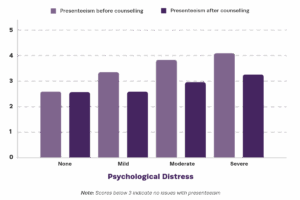
Psychological Distress and Presenteeism
Measured using the PHQ-4 severity levels for psychological distress (none, mild, moderate or severe).
We further examined presenteeism outcomes by comparing them with levels of psychological distress before and after counselling. Unsurprisingly, initial presenteeism was higher for employees with greater psychological distress. However, we saw the following notable changes after counselling:
- Employees who initially indicated mild or moderate distress had presenteeism scores that no longer differed significantly from those who initially reported no distress, indicating a return to normal levels of work functioning.
- While the follow-up presenteeism scores for those with severe psychological distress remained higher than the group with no distress, these employees still had major improvements from where they started.
The Takeaway: Workplace Outcomes
Arcora’s counselling journey doesn’t just improve mood and resilience—it increases work capacity, which is one of the most valued aspects of recovery for employees and organizations alike.
These findings highlight the effectiveness of our supports, which led to meaningful reductions in presenteeism across all employees. For the majority of those who began with work impairment, this meant a return to normal levels of work functioning.
It’s expected that some clients with high support needs may benefit from additional counselling, though employees who started with severe distress did experience substantial reductions in work impairment.
The dual benefit of mental health and performance defines Arcora’s impact and underscores the value of our services.
Client Satisfaction
As employees reach the end of their counselling journey, they frequently express deep satisfaction with their counsellor and Arcora’s services. As we always strive to provide human-centered, empathetic care, we take pride in client feedback that reflects this approach in action.
These results highlight the meaningful connections formed between counsellors and clients and the lasting impact of Arcora’s comprehensive and flexible counselling.
Outstanding Arcora Experiences
Client insights10 indicate that the majority of employees feel genuinely supported by their counsellor. This affirms the effectiveness of both Arcora’s comprehensive matching process and our compassionate, skilled professional network. In that same vein, high EAP satisfaction scores show that employees are recognizing positive changes through our solution-focused counselling.
8.3 out of 10
Average counsellor satisfaction score
8.5 out of 10
Average EAP satisfaction score
Data Snapshot: Overall Satisfaction
When asked to rate their satisfaction with their counsellor and Arcora’s EAP on a scale of 0 to 10, the majority of employees reported highly favourable experiences—indicating appreciation for the care they received from their counsellor, as well as the effectiveness of our supports:
- 85% of clients rated their counsellor satisfaction at 7 or above, with 78% rating 8 or above.
- 89% of clients rated their EAP satisfaction at 7 or above, with 80% rating 8 or above.
A Transformative Journey
As employees complete their counselling journey with Arcora, they often find themselves in a better place both personally and professionally. The consistently positive client feedback we receive is a testament to the lasting impression of our quality, person-focused supports—and the profound difference we make in our clients’ lives.
10 n= 3,485
Recommending with Confidence
When an employee has concluded their counselling journey, their willingness to recommend Arcora’s services to others is an important affirmation of their experience. Offering a recommendation not only signifies personal satisfaction—it shows that the employee sees value in our supports and recognizes the potential benefit for their colleagues.
Promotion Insights
Because peer endorsement is a powerful tool for promoting use of EAP supports, we regularly monitor this using a standard client satisfaction measure, the Net Promoter Score (NPS). The latest insights11 from client NPS scores indicate that:
- 70% of employees are very likely to recommend Arcora services.*
- 20% of employees are satisfied with Arcora and would also likely recommend our services.**
*NPS of 9 or 10 out of 10 | **NPS of 7 or 8 out of 10
Our analysis shows that 9 out of 10 employees found Arcora’s counselling valuable enough to encourage others to access support, regardless of their specific challenges or therapeutic preferences.

Completing the Circle
When an employee recommends Arcora to a colleague, it brings well-being full circle—one employee’s journey leading to another’s. Each satisfied client that becomes an advocate helps to naturally sustain an enduring culture of support, reinforcing the qualities that define Arcora: compassionate, human care.
11 n=110
Beyond the Circle: Organizational Outcomes

We’ve seen the impacts of Arcora’s supports on employees’ work and personal lives—now that the counselling journey has come full circle, we’re concluding with a look at the many organizational benefits of Arcora’s mental well-being and EAP solutions.
Individual and Organizational Gains
Arcora’s pretest-posttest data confirms substantial improvements in mental health and psychological distress levels for employees who completed counselling. This translates into real cost savings for employers through enhanced employee well-being, financial efficiency and workforce stability—stemming from increased productivity, as well as reduced absenteeism and presenteeism12.
Arcora’s counselling supports generate an average financial ROI of $11 for every $113
Healthier Workforce, Healthier Business
Another Arcora study14 found that employees who successfully addressed their issues through counselling were 3.3 times less likely to make a long-term disability claim than those who did not. This reduction directly impacts organizational expenses through lower insurance premiums and long-term absence costs, and highlights Arcora’s role in creating a healthier, more resilient workforce.
Arcora’s proven results are not just encouraging—they’re transformative for HR and business leaders.
An investment in a comprehensive, customized Arcora solution is an investment in your greatest asset—your people. The returns are measurable improvements in employee well-being, engagement and productivity.
12 Milot, M. (2019). The impact of a Canadian external Employee Assistance Program on mental health and workplace functioning: Findings from a prospective quasi-experimental study. Journal of Workplace Behavioral Health, 34(3), 167–191.
13 Milot, M. (2020). Employer ROI for the Arcora EAP.
14 Milot, M. (2020). A Researcher’s Inside Look at the Impact of Employee Assistance Programs. Plans & Trusts: January/February 2020.International Foundation of Employee Benefit Plans.
Key Terms
Measuring Effect Sizes
Cohen’s d is a standardized effect size used to indicate the difference between two averages. In psychology and mental health research, it describes the standardized size difference between data from two groups (e.g. before and after accessing counselling).
Beyond statistical significance, it helps with interpreting how meaningful the change is. Arcora uses the following standard interpretations from psychology research:
| Cohen’s d Range | Effect Size and Meaning |
| 0.10 – 0.25 | Small: a small but noticeable change |
| 0.26 – 0.50 | Medium: a moderate, meaningful change |
| 0.51 – 0.80 | Large: a strong, impactful change |
| 0.81+ | Very Large: a major and highly impactful change |
Measuring Anxiety, Depression and Mental Well-being
Patient Health Questionnaire (PHQ) in this context refers to validated self-report questionnaires used to screen for depression. Generalized Anxiety Disorder (GAD) in this context refers to validated self-report questionnaires used to screen for anxiety. For these tools, the number after the acronym indicates the number of questions/subscales (e.g. the PHQ-9 has nine).
- PHQ-9 and GAD-7 are the full-length instruments used to screen for depression and anxiety, respectively.
- PHQ-41 is a four-item validated tool combining two subscales—PHQ-2 (depression) and GAD-2 (anxiety).
- The PHQ-2 and GAD-2 strongly correlate with PHQ-9 and GAD-7, and are widely used in clinical and workplace settings for their efficiency and strong psychometric properties.
- A positive screening on the PHQ-4 indicates that an individual meets the threshold for depression, anxiety or both—meaning their symptom severity is high enough to warrant clinical attention, based on validated cut-off scores for the applicable sub-scale(s).
WHO-52 is a five-item self-report questionnaire from the World Health Organization that measures mental well-being. This tool is grounded in positive psychology and widely used to assess flourishing, resilience and life satisfaction.
- The raw score—which is calculated by combining the scores for each of the five questions, for a maximum of 25—is multiplied by four to determine a percentage score out of 100. Percentage scores below 50 are indicative of poor mental well-being.
Measuring Workplace Outcomes
The Workplace Outcome Suite (WOS)3 is a validated self-report questionnaire that’s backed by the Employee Assistance Professionals Association (EAPA) and used to measure the impacts of employee assistance programs on workplace functioning. Arcora uses the single-item measure of presenteeism, asking employees about whether personal issues are making it difficult to perform effectively at work.
Measuring Employee Recommendations
The Net Promoter Score (NPS)4 is a standard measure of client experience that asks individuals to rate the likelihood they will recommend an organization, product or service to a friend or colleague on a scale of 0 (not at all likely) to 10 (extremely likely). The NPS categorizes respondents based on scores, as follows:
- Detractors (0-6)
- Passives (7-8)
- Promoters (9-10)
The final score, which falls between -100 and 100, is calculated by subtracting the percentage of Detractors from the percentage of Promoters. Arcora’s score is 59.1, which is considered excellent by NPS standards.
Significance of Results
Findings in this paper all have a probability value (p-value) of p < 0.05, which indicates statistically significant results.
1 Kroenke, K., Spitzer, R. L., Williams, J. B. W. & Löwe, B. (2009). An ultra-brief screening scale for anxiety and depression: The PHQ–4. Psychosomatics, 50(6), 613–621.
2 Topp, C. W., Østergaard, S. D., Søndergaard, S. & Bech, P. (2015). The WHO-5 Well-Being Index: A systematic review of the literature. Psychotherapy and Psychosomatics, 84(3), 167–176.
3 Lennox, R. D., Sharar, D. A., Schmitz, E., & Goehner, D. B. (2018). Validation of the 5‑item short form version of the Workplace Outcome Suite©. International Journal of Health & Productivity, 10(2), 49–61.
4 Adams, C., Walpola, R., Schembri, A. M. & Harrison, R. (2022). The ultimate question? Evaluating the use of Net Promoter Score in healthcare: A systematic review. Health Expectations, 25(5), 2328–2339.